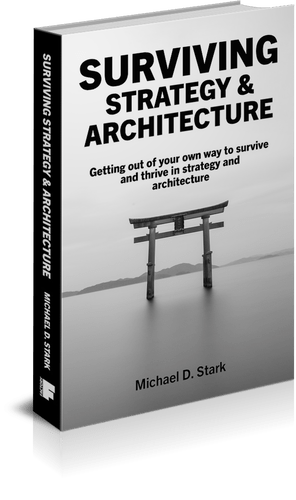
The book, Surviving Strategy and Architecture, has been released as a paperback on Amazon via KDP.
This book is about how to survive and thrive in the highly rewarding, but emotionally taxing, world of technology strategy and architecture.
This book is not specifically about strategy or architecture, it is about you, the strategist or architect. More specifically it is about you, the human being.
BUY the BOOK Today and Think Differently
+ all other Amazon marketplaces (supported by KDP) in English language
Formats: Paperback, Audiobook out early 2025
Platforms: Amazon (live) with other booksellers ASAP via Ingram Spark, and Audible (early 2025)
Publisher: Factory (self-publish platforms)
Introduction
If you do not know about technology strategy and enterprise architecture before reading this book, then you will not know about technology strategy and enterprise architecture after reading this book. There are other good, and not so good, books about technology strategy, and about enterprise architecture. This book is not a book about strategy or enterprise architecture, it is a book about you, the technology strategist and enterprise architect. This book it is about you, the perfectly imperfect human being.
This book is about how to survive and thrive in the emotionally taxing, and often humbling, worlds of technology strategy and enterprise architecture.
In our profession we can feel like we are expected to be beyond human. We are supposed to be like Spock on Star Trek (original series), or Data on Star Trek: The Next Generation, if you are late Gen X or Millennial; if you are Gen Z or later you’ve probably got something similar on The TikTok. We must be logical and rational, following the deterministic tramlines that lead to the ideal target state for our company or organisation. Yet here we are, being human. Getting frustrated. Getting disappointed. Perfect and human.
We often find our work life rather unsatisfactory, and frustratingly illogical.
Why Strategy and Enterprise Architecture
Let’s clear up the ‘and’ between [Technology] Strategy and Enterprise Architecture. I tend to be in the camp that Enterprise Architecture includes technology strategy, and it would be hard to do one without the other. However, I have experienced operating models where these two were closely related, but separate, and I ended up seeing that there are some advantages. In my situation the strategists had some strong management consulting experience which is rare for pure Enterprise Architects, and some other amazing strategists with strong merger and acquisition experience, which also proved very helpful. People are unique, and have many different experiences and skills, so popping people in any one box is often unhelpful.
Another reason for the arguably dual focus is to get the right key words in the name of the book so it would have appropriate hits on the distribution platforms. As an Enterprise Architect I naturally explored the business model for self-publishing platforms and determined how they work. Having both strategy and architecture in the name keeps the audience segment tight enough to not get lost in the crowd, but broad enough to have the desired audience included.
What’s is in the tin?
This book is divided into 4 sections each centred around a way of thinking about our profession and aligning to the core theme. That theme is the subtitle for this book:
Getting out of your own way to survive
and thrive in strategy and
architecture.
Section 1: Getting Out of Your Own Way
We tackle this theme head on to try to jolt our way of thinking and open ourselves up to the other concepts. It took me about 10 years to explore many of these concepts and adapt my way of seeing. Trying to achieve this in one section is rather ambitious, so let me know how I go. If you can glimpse that something is there, then that is all I can ask. If you just can’t connect with this section, it is fine to skip it, and perhaps even try coming back to it at the end, or perhaps even at some future time when you are ready.
Section 2: The Other Strategy and Architecture Skills
The many books, videos, podcasts, articles, and courses about strategy and architecture cover the central concepts we need in our careers. In this section we take a different lens and explore other useful skills that we can perhaps leverage from the worlds of business, engineering, sports, science, psychology, and even nature.
Section 3: Understanding the Game
To really survive and thrive we need to dig deeper into the various games that we play as companies, organisations, divisions, teams, and as humans. This important section builds on the prior sections to help you understand what is and is not within your control. By understanding the game better, we can be more successful, and more accepting of our situation. We also need to consider how we will play the game, and how we will stay true to our beliefs and values.
Section 4: Maturing Strategy and Architecture
We bring it back to logic and reason structured around the four Western Philosophy branches carefully blended with Eastern Philosophy concepts. We look at how these philosophical concepts can strengthen our muscle strength, and how philosophy in the West has helped other disciplines mature, such as physics and biology, but even arguably medicine and mathematics. We ask if philosophy can help our discipline mature.
This all seems a bit casual, e.g. where are the citations?
Ok, so I’ll be honest. I want to have a conversation with you. Strategy and Architecture roles have treated me very well over the years, and I’ve had many great leaders’ who have cared enough to have taken the time to mentor and coach me. At this point in my career, I feel like I want to give something back – not the money – but something (to paraphrase the head of the EPA from The Simpsons Movie).
This book takes some of what I picked up from those leaders, along with many of the great Eastern and Western though leaders of history, and some great contemporary thinkers. I try to blend all this with my own observation and thoughts, and then take what of all that makes it through my own biases and filters.
This book is not an academic work. I will often touch lightly on my viewpoint of these topics. I won’t be citing references which you could expect in an academic work or a book stating facts about the world. I take a minimalist approach aimed at providing just enough information to be useful and point you towards various paths you might wish to explore.
Everything in this book is my understanding and interpretation of what I’ve seen, heard, and read. I will refer to and credit all the original sources that my porous memory can recall. One thing I have learnt is that nothing is independently original in the endless chain of causation. As nicely stated by Carl Sagan, “If you wish to make an apple pie from scratch, you must first invent the universe”.
If I cover a concept that you know in depth, you should probably just skip over it, so you don’t get frustrated by the relatively light treatment needed here; we have much of the planet and about 2600 years to cover. However, if I cover a topic that you find interesting and useful, then consider doing your research as there will likely be more to it than I can cover here. I know you can research your topics as that is a core skill you use every day. Youtube is a great source, as are podcasts, books, and audiobooks. I’ve learnt the information in this book by an even balance of each of these sources and you can find recommendations at thinkingea.com or michael.d.stark.com, along with any new thinking on these topics.
What you’ll get
What I’m giving you in this book is some stand-alone useful concepts, a broadening of perspective, and above all breadcrumbs that you can, if you choose, follow down the very rich and rewarding paths that are open to anyone who is curious. My own trail of breadcrumbs started with Alan Watts and expanded out in many directions.
My hope is that by reading this book you will be a more successful strategist and enterprise architect, however my deepest motivation is that you might become a happier one, with more satisfaction, understanding, and contentment in your journey, wherever it might take you.
Ngā mihi maioha
Michael D. Stark

 thinking humanistically about enterprise architecture