How do you know what you know? What role does your character play in knowing?
Let’s explore if epistemology, virtue epistemology, and ethics could help navigate this brave new world.
Read more: brave new world – virtue epistemologyAs if the corporate world wasn’t hard enough to navigate, we now have all sorts of knowledge challenges, from the usual vendor hype, media hype, and neoliberal games, through to social media, podcasts, and youtubers.
Add into this the current AI hype and the double edge sword of actual LLM output!
So how might epistemology, virtue epistemology, and ethics help?
epistemology
Epistemology examines the nature, origin, and limits of knowledge. It is also called “the theory of knowledge”, and is one of the four main branches of Western philosophy.
Epistemology can help, and I see clear links to identifying not only direct knowledge, but importantly the limits of our knowledge, which can be where we need to experiment, test and learn, or sometimes just acknowledge we are guessing.
Epistemology is not just about how to be right, but how to be right for the right reasons.
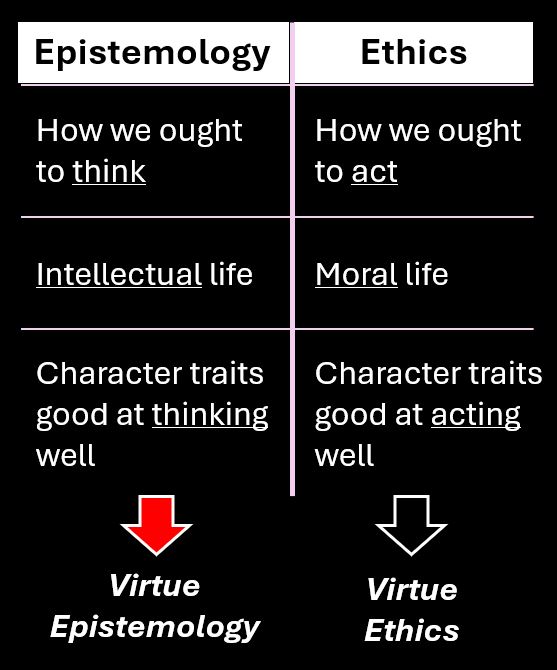
Epistemology is normative, which is to say it doesn’t just describe how we think, but how we ought to go about thinking to get to knowledge.
However, this is all very rational and logical, but we are not robots. We are not Spock from Star Trek.
Our human side cannot be ignored.
Virtue Epistemology
With virtue epistemology there is a focus on various character traits, or habits of thinking, that can be considered epistemic vices and virtues.
An epistemic virtue is a character trait or way of thinking that helps us gain knowledge, whereas an epistemic vice is a character trait or way of thinking that obstructs knowledge.
Being curious would be a virtue whereas being unwavering in this context could be a vice.
Now being unwavering can be good in other areas, but in terms of getting to a justified and true belief it might not be.
Sometimes the combination of traits might be key.
Being skeptical could be either a virtue or a vice depending on other factors. Less likely to believe non-truths, but also less likely to believe truths.
Being skeptical and unwavering would probably be an epistemically unhelpful combination.
Why Ought You Care
As we move forward with our knowledge landscape, we need to uplift our knowledge-forming hygiene. Philosophy, in particular critical thinking, and epistemology, can set you apart from the crowd and make you more effective.
Virtue epistemology is the focus area for my daughter Georgia Bramley who has recently started a PhD scholarship in this field.
It is quite challenging to consider that your virtues play a part in what you know, but recent history suggests this is the case.
This also brings in a closely related field of philosophy, which is ethics. Even once you get to knowledge, it might not be what leadership want to hear, they might not respond well, so you have an ethical challenge.
Do you see epistemology, virtue epistemology, and ethics as key areas in our brave new world?
“what we know is not even capable of being otherwise; of things capable of being otherwise we do not know” – Aristotle, Nicomachean Ethics, 350 B.C.E
Kind regards
Michael D. Stark
 thinking humanistically about enterprise architecture