What is strategy?
This might be an odd sounding question, yet like other common concepts, it is something we all know the meaning of until we must give a clear explanation of it. Take a moment to define how you would explain what strategy is to someone that didn’t just know.
In this article, which is a chapter from the below book, we explore what good strategy is, and have a great, perhaps the greatest, example from the sporting world to guide our thinking.
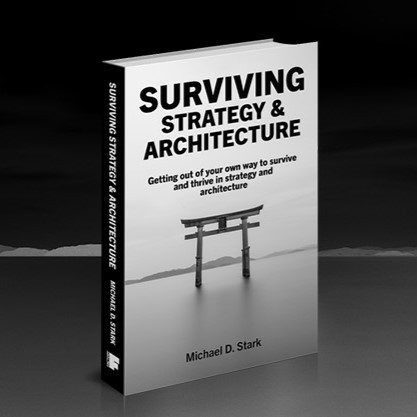
Read more: what is a good strategy? (chapter 23)This chapter is posted in its entirety from the below book, available now.
“The essence of strategy is choosing what not to do.”
– Michael E. Porter
I have felt uncomfortable about what gets called strategy for many years now, not only in technology (including some of my own past strategy work), but also corporate strategy overall. I have come to understand that good technology strategy needs to be aligned tightly to good corporate strategy. If the corporate strategy is poorly defined, then we are on the back foot to start with.
The entire strategic context has changed since the rise of the internet, mobile, GPS, platform business models, digital B2B models, data leverage, and A.I. or at least machine learning. Today there are very few companies, governments, or other organisations, where technology isn’t simply a fundamental part of good business strategy. However, for it to be a good strategy it must go beyond trendy soundbites, and regurgitated industry cliches. It must be highly targeted, resource constrained, action based, and solve the most pressing challenges, or take the most valuable opportunities where the company has an advantage that it can leverage.
A McKinsey email recommending must-read books gave me a breadcrumb to follow when it recommended Good Strategy Bad Strategy by Richard Rumelt. Richard, who was described in a 2007 McKinsey article as being “Strategy’s strategist”, is an uncompromising master at calling out bad strategy with some great quotable soundbites such as “many bad strategies are just statements of desire rather than plans for overcoming obstacles.”
This chapter is not about describing how to do strategy, either business or technology, but rather it to what even is strategy. I even think of it as differentiation an actual strategy from something called a strategy that just isn’t. This can include many technology strategies that simply give background information, perhaps with an ideal target, or unconstrained roadmap, but don’t address the hard problems of how to do it in the real business context. I can’t cover doing strategy in just one chapter; there are some good resources for strategy available now via learning platforms like Udemy, EDX, LinkedIn Learning, and Coursera. For example, Udemy has Management Consulting Essential Training, MBA in a Box, and on EDX, Oxford Executive Strategy Programme, Digital Transformation Strategy (Yale) etc. In these courses you will get an overview of leading methodologies and tools such as Porter’s Five Forces, SWOT, PESTEL and others. Just be mindful that tools and methods help, but ultimately there is no magic method to get a unique winning strategy. That is the point of competition. Imagine buying a guaranteed Football World Cup winning strategy from a consultant; I hope they don’t sell that to two aspiring teams!
In the end you can learn some concepts, but you’ll learn a lot more when you just start doing it. If you can get to work with some fantastic strategic thinkers, as I have been lucky enough to, then you will learn much from them; pay attention and ask questions. Be respectful always. Finally, be aware that, as with the business case game, strategy development operates at multiple levels. Getting acceptance of your strategy, or strategic advice, is one thing, being able to execute it is a separate issue, and then having the strategy actually work is another thing altogether. Also, recall the lesson from the Bhagavad Gita: you can only do the right actions, you cannot control all factors, so you cannot guarantee the outcome. Luckily, most companies tend to declare strategies successful, or politely pivot and hope nobody asks about it.
Not a strategy
“At the core, strategy is about focus, and most complex organizations don’t focus their resources. Instead, they pursue multiple goals at once, not concentrating enough resources to achieve a breakthrough in any of them.”
― Richard P. Rumelt, Good Strategy Bad Strategy
I do highly recommend reading Richard Rumelt’s book Good Strategy Bad Strategy, and his follow-up The Crux, the former focusing brutally, and amusingly, on what is bad strategy along with defining good strategy. The later book has some good guidance on getting to the crux of the problem or opportunity to evolve the strategy. You can also find some good presentations from him on YouTube, and appearances on podcasts. Now for me, I tend to differentiate things into three categories: good strategy, bad strategy, and non-strategy being called strategy.
Richard identifies four hallmarks of a bad strategy, and if one or more are present, then be suspicious.
First is fluffy language. So, buzzwords or cliches would for us be an example, perhaps having phrases like best-in-class, or one of my pet hates being the so-called best practice, along with any suggestion of an out-of-the-box implementation strategy, unless of course it is a coffee table from IKEA.
Next Richard calls out failure to identify and face the real key problem. You must have a clear challenge to achieve, or obstacle to overcome. From my viewpoint, particularly with technology strategy, I’d say we are often identifying problems for us in technology, but not very clearly showing why it is top business problem, meaning in a way that the strategy would clearly solve a problem that the business cares about, and in a timeframe that matters to them. For example, complexity of technology systems is often called out as the problem, challenge, or constraint. This might be true, but we need to be clear exactly how this causes a real pressing problem for the business, and why it is the most urgent problem for them to solve because resources are limited and there is much they need to do. We also need to be clear on specifically how and when our strategy will solve this problem.
Third, Richard identifies what is probably the most common hallmark of bad strategy, or non-strategy, we see in our businesses, which is defining goals and calling them strategy. For us an example might be an insurance company saying their strategy is to grow by 250 thousand customers, and 500 thousand policies, while reducing their expense ratio to 22% from 25%; these are goals and not strategy as they don’t indicate how these outcomes will be achieved, and what the trade-offs are. It is just stating wishes. This would be like the coach of a Rugby team going into the World Cup Final saying his strategy is to win the game, which is a wish or hope. He might clarify this statement by saying that his strategy is to score more points than the opponent team, which is only restating to win the game.
Related to this we can include strategic objectives which are unclear, don’t solve a real problem, or are just impractical. For example, a motorcycle manufacturer might have a strategy to become the leading truck manufacturer by the end of the decade by leveraging their motorcycle manufacturing expertise and supply chain economics. The expertise from designing and building trucks would seem very different than it would be for motorcycles, and even if they could figure it out, it seems unlikely customers would be keen on buying trucks from such a company. So, this doesn’t really make logical sense. In addition, the need to focus energy is key, so having too many goals and too many actions defined in a strategy is not going to work. Even if you pick good goals and sound actions to achieve them, if you just spread your focus too wide, you are unlikely to execute well. This is a common problem for governments who need to promise too much to all the various special interests they need support from to get elected.
A good strategy story
“The most basic idea of strategy is the application of strength against weakness. Or, if you prefer, strength applied to the most promising opportunity.”
― Richard P. Rumelt, Good Strategy/Bad Strategy
Good strategy is all about focus. Specific targeted actions, applying leverage where you have a potential advantage to achieve a defined strategic outcome, and giving up some things you would like to do or have, because you understand you cannot do or have everything.
Strategy is often about choices, and I don’t mean choosing between a new BMW or a Tesla but choosing between a new BMW or a second-hand Toyota, so you also have a deposit for a house; you are giving something up, to achieve an important outcome. A nice clear example of this can be found from the sporting world.
On February 13, 2022, one of the greatest strategic gambles in sporting history paid off when the LA Rams won Super Bowl LVI. The Rams had moved from St Louis, Missouri, to the much warmer Los Angeles in 2016. The Rams had previously been based in LA for almost half a century (1946-94) until poor performance, an outdated stadium, and waning crowds, motivated them to move to Missouri. Super Bowl LVI was played at the spectacular new 5-billion-dollar SoFi Stadium which had tempted the Rams back to LA (along with tempting the Chargers there from San Deiago). In the second season the SoFi Stadium was open it was the location for the season 2021 final, and the Rams desperately wanted to win it all; they wanted to win their division, the NFC West, their conference, the NFC, and the NFL title, the Superbowl. That was the objective, and they were prepared to go all-in to achieve it.

The key to understanding the Ram’s strategy is understanding the draft system and salary cap in the NFL, which is the top American Football competition and culminates in the Superbowl. As with everything in the NFL it is complex and nuanced, but basically there is a limit on how much each NFL team can spend on players, and this is to try to keep the game more competitive, meaning that as teams have more success, they have to pay their talent more, and therefore due to salary cap restrictions some of that top talent will go to teams that can pay higher because they have fewer top players already.
There are three main ways to acquire players with the main one being the NFL draft, where top talent from College Football can be drafted by teams. There are seven rounds and teams normally get to pick one player per round. Importantly the lowest ranking teams pick first, to give them a chance to improve, and even more importantly for this strategy, you can trade draft picks in future years and cash to acquire players from other teams, which is the second way to get new players. Finally, there are free agents, which are players that are off contract that teams can pick up.
The basic strategy for the LA Rams to win Super Bowl LVI was to go all-in for one big season. They targeted the 2021 NFL season with the Superbowl in their new stadium on 13 February 2022, and were prepared to accept the following years would be much tougher. They targeted proven veteran players and traded early round draft picks to teams to get them. This included Mathew Stafford, Von Miller, and an important cameo by Odel Beckham Jr. There was some sound logic, because picking stars from college football often doesn’t pay off in the more intense NFL. They did have a good base of home-grown top talent like Cooper Kupp and Aaron Donald to blend the acquired veteran talent with, along with a few rookies. The Rams accepted they’d get good players, but they’d not get them for long. The strategy was to try and peak in all phases of the game at the same time: offence, defence, and special teams. Getting a top running game and passing game at the same time is hard to do under the salary cap. They really had one shot.
The biggest bet was trading their star franchise quarter back, Jared Goff, who had taken them to the Super Bowl in the 2018 season but lost to some chap called Tom Brady. The following years the team didn’t gel, and the Rams traded Goff for veteran Detroit Lions quarterback Matthew Stafford (not Nietzsche who is my LinkedIn prop), for whom thy had to throw in a valuable first-round pick in 2022 and 2023 to Detroit as well as a third-round pick in 2021. Goff has since had huge success at the Detroit Lions, largely motivated by a massive chip on his shoulder. Sometimes you have great pieces, but they just don’t quite fit, which needs a strategic change. Identifying that was a masterstroke for the LA Rams. Trading for the veteran Matthew Stafford they knew he would be able to quickly build cohesion and lead the stitched together collection of veterans, existing players, and rookies. It was a bit like The Expendables 2, with Stallone, Schwarzenegger, Van Damme, Willis, Lundgren, and Norris.
To be fair there are many teams that have tried a similar all-in strategy over the years, and it hasn’t paid off. The LA Rams did this in a balanced way and executed it very well. In competitive areas like football, like in business it is a competition, and no strategy is a guarantee, but you can give yourself a good shot.
Beyond just winning the Superbowl, and winning it in their brand-new home stadium, their longer-term strategy was to build a very loyal and committed fan base in LA that would be a foundation for decades. The loyal fans do indeed seem to be accepting a couple of lean years since then. In Richard Rumelt’s view the kernel of a good strategy has 3 elements, which are: a diagnosis of the challenge (we can’t afford to have top talent in all positions), a guiding policy, which I’d call a strategic approach for dealing with the challenge (go all in on one big season), and a set of coherent actions to carry out the policy (trading draft picks for proven talent). Importantly the outcome was also very clear, being that they aimed at winning the Superbowl in their new stadium, so it was do or die; there was no option for a partial success.
I think the 2021 LA Rams got this right, and with some luck at times (e.g. few injuries, so not exposing depth weaknesses), the Rams did win it all. Don’t underestimate chance; a lesson from the Bhagavad Gita.

Technology strategy
“A hallmark of true expertise and insight is making a complex subject understandable. A hallmark of mediocrity and bad strategy is unnecessary complexity—a flurry of fluff masking an absence of substance.”
― Richard P. Rumelt, Good Strategy/Bad Strategy
All the above regarding good and bad strategy applies to technology strategy. That said, any technology strategy must be part of, compliment, or execute actions of, an overall business strategy. I cannot think of any reason you would only have a technology strategy, even if you are doing it for a technology company, it is still a company, and it does not exist in a financial vacuum.
I can imagine situations where you don’t need a stand-alone technology strategy, which is not to say there are not strategically aligned technology actions; you just might not need to make it a big separate thing. There is an interesting relationship between technology strategy and the definition of a technology target state or roadmap. I see a lot of target states and roadmaps created without clear and tight linkage to business strategy. I see a lot of target states and roadmaps created in an unconstrained manner, where it is a theoretical ideal, but not aligned with investment appetite, or overall financial reality for the company. It might be intellectually fun, but I don’t see the point in doing these. More about this in a later chapter called The Nature of Target State Architectures.
An example of the type of business strategy aligned technology problem that insurance companies have faced in recent decades is increasing their digital capability while managing risk and reducing the total cost of ownership of aging legacy core insurance systems. It is a tough balancing act. There have been similar problems for banks.
Thinking about Richard Rumelt’s kernel of a good strategy it is often deemed clear what the diagnosis of the above challenge is, however, I’d caution against jumping to quickly to any conclusions. We need proper analysis of the technology and business challenges to ensure we clearly understand the real problem for the business. The problem is not that we need to replace core systems, that might or might not be the approach to solve the problem; but the shareholders, customers, and other stakeholders don’t really care what the underline core systems are.
The guiding approach for dealing with the challenge is crucial to get right. So, for our aging legacy core systems, remember the earlier chapter with the story about the container full of frozen mackerel; sometimes the most sensible approach really is to kick the can down the road. Also, there could be an approach that can allow you to bleed the asset for longer. Core systems are not like old Toyotas; you don’t get to trade them in an gets some value back, so bleed the assets for as long as it makes sense, just be careful about the total cost of keeping it, including risk and opportunity costs. Therefore, your approach might be to defer, with some uplift, or to replace the core system. If you are going to replace it you might go for a full replacement, or incremental replacement using something like a strangler pattern to shrink it incrementally over time.
Replacing a system is sexy, but consider carefully how much capability you are uplifting, verses just replacing, and what the value of that uplift is to the business. I’d estimate that most insurance core system replacements involve replacing 80% or more of functionality that works well enough already, such as the policy lifecycle functions like renewal processing. Even with the 20% that doesn’t work well the approach is often to implement like-for-like with uplift to happen later.
Alternatively, an approach some banks use is to decouple their legacy core, if that core is stable, from their digital layer, sometimes with fully asynchronous data decoupling patterns. This is very complex, but if done well can greatly improve digital capabilities while not involving a risky core replacement. All these approaches can be appropriate in various situations. Make sure you understand the problem carefully, from a business perspective, and be honest about what approaches might work. Above all don’t believe your own propaganda as in the end your company will wear the impact.
And finally, a set of coherent actions to carry out the chosen strategic approach. This gets very nuanced depending on the situation. I do often see a large gap between the problem definition, the overall policy or approach, and the specific actions that get defined. Care must be taken to ensure there is tight logical cohesion between these. If the approach is to replace the core, then actions might be to select a package, or compare that to a build your own approach. If you are going with a strangler pattern, then it might make sense to go with a more modular approach like microservices.
The key is to ensure that all these choices are coherent. Don’t forget to look beyond the technology and patterns and consider your expertise as well. You might need to re-train people, and perhaps mix it with new hires; remember the LA Rams brought in proven veterans. If you are doing a decoupled pattern, then you really need to try to blend in some old war horses that have some scars from previous implementations. If you are going with an event driven architecture, or event streaming, then start slowly with low-risk areas, and not with the most important areas first. Be realistic.
Finally, my pet-hate: if you are providing strategic options for leadership do not put forward an option that they cannot realistically pick. If you look at an approach that is not viable call it a discarded approach and explain why. In the last few years, I’ve started relying on MECE pyramids to frame up possible approaches, and discard approaches based on feasibility, desirability, and viability. MECE is a great tool for the toolkit from the management consulting world and something you should explore yourself. It works very well for communicating to the executive level as it shows them your logical thinking and makes it easy for them to be confident you haven’t missed anything, or importantly communicating to you something else you should consider. Call what you triage out discarded approaches rather than calling them options. Do not call them options until they can be selected.
You know what it is like when you go to a restaurant and pick the baked cheesecake for dessert, only to be told they don’t have it available. Why was it an option to pick.
Kind regards
Michael D. Stark
 thinking humanistically about enterprise architecture
The lack of a common epistemology is perhaps the greatest barrier to EA’s intellectual development. It’s not just strategy that we can’t define, few can even define architecture. I frequently ask the strategy question and the usual response is the stunned silence of realization! However, I diverge, the definition I have found most useful – strategy is a path to a position of advantage.
LikeLike